
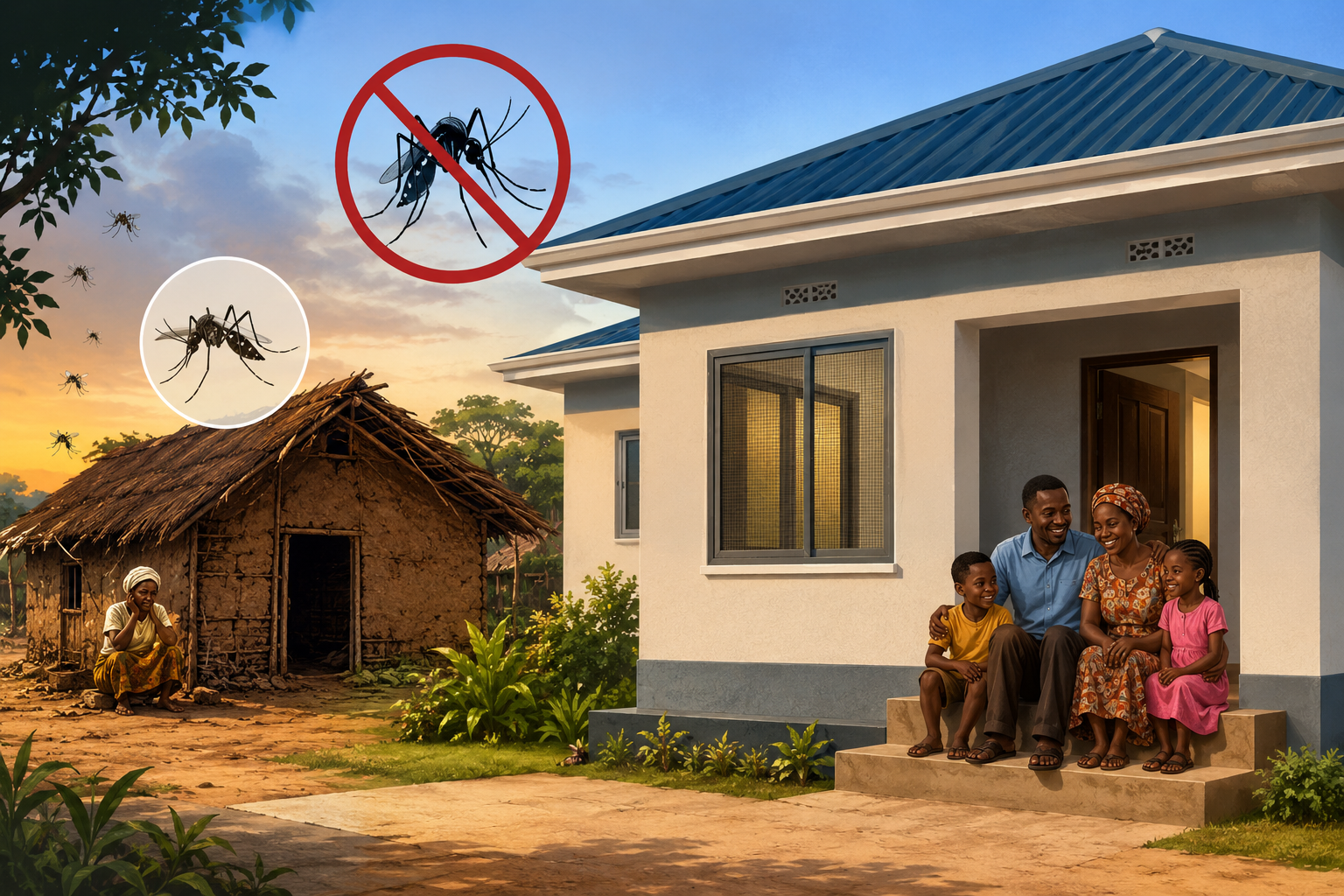
Children living in modern homes across sub-Saharan Africa are significantly less likely to contract malaria than those living in traditional housing, according to a new study, which suggests better housing could become an important tool in the fight against the disease.
The study, published in Social Science & Medicine, analysed data from more than 206,000 children in 17 countries across sub-Saharan Africa. Its author found that children living in modern dwellings had lower rates of malaria infection, even after accounting for factors such as household wealth, mosquito net use, sanitation, and environmental conditions.
The author of the study argues that housing should be viewed as more than just a place to live. “This study treated modern housing as a social determinant of child health,” the paper states.
The findings suggest that the quality of a home can directly influence a child’s risk of exposure to malaria-carrying mosquitoes.
“Children living in modern dwellings had lower probabilities of malaria RDT positivity than children in non-modern housing,” the author wrote. The relationship remained consistent even after controlling for other well-known factors associated with malaria risk.
Malaria is transmitted through the bites of infected mosquitoes, many of which feed indoors during the evening and nighttime hours. Modern homes are often built with improved walls, roofs, floors, and other structural features that can reduce mosquito entry and limit human exposure.
One of the key findings was the consistency of the results across different environments. The protective effect of modern housing was observed in grasslands, forests, coastal areas, and higher-altitude regions, despite variations in climate and malaria transmission patterns.
According to the study, “modern housing is consistently associated with lower malaria risk across all ecological contexts.”
The author also found that the benefits of better housing were greatest in areas where malaria transmission is highest.
“The modern housing association was strongest in the high-transmission environments where the burden of malaria is concentrated,” the study notes.
The findings add to growing evidence that malaria is influenced not only by biological factors and individual behavior, but also by broader social and environmental conditions.
The study argues that “population health inequalities in malaria are not reducible to individual behaviour or biomedical exposure alone.”
While interventions such as insecticide-treated mosquito nets, indoor residual spraying, rapid testing, and effective treatment remain essential, the author argues that housing quality should also be considered part of long-term malaria control strategies.
The study describes housing as a form of protective infrastructure that can shape exposure to disease. It argues that unequal access to safe and modern housing contributes to differences in health outcomes between communities.
“Malaria risk reflects unequal access to protective domestic environments,” the author writes.
The findings come as African countries continue efforts to reduce malaria-related illness and deaths. Although substantial progress has been made over the past two decades through existing interventions, malaria remains one of the leading causes of illness and death in many parts of the continent.
IMAGE IS AI GENERATED