
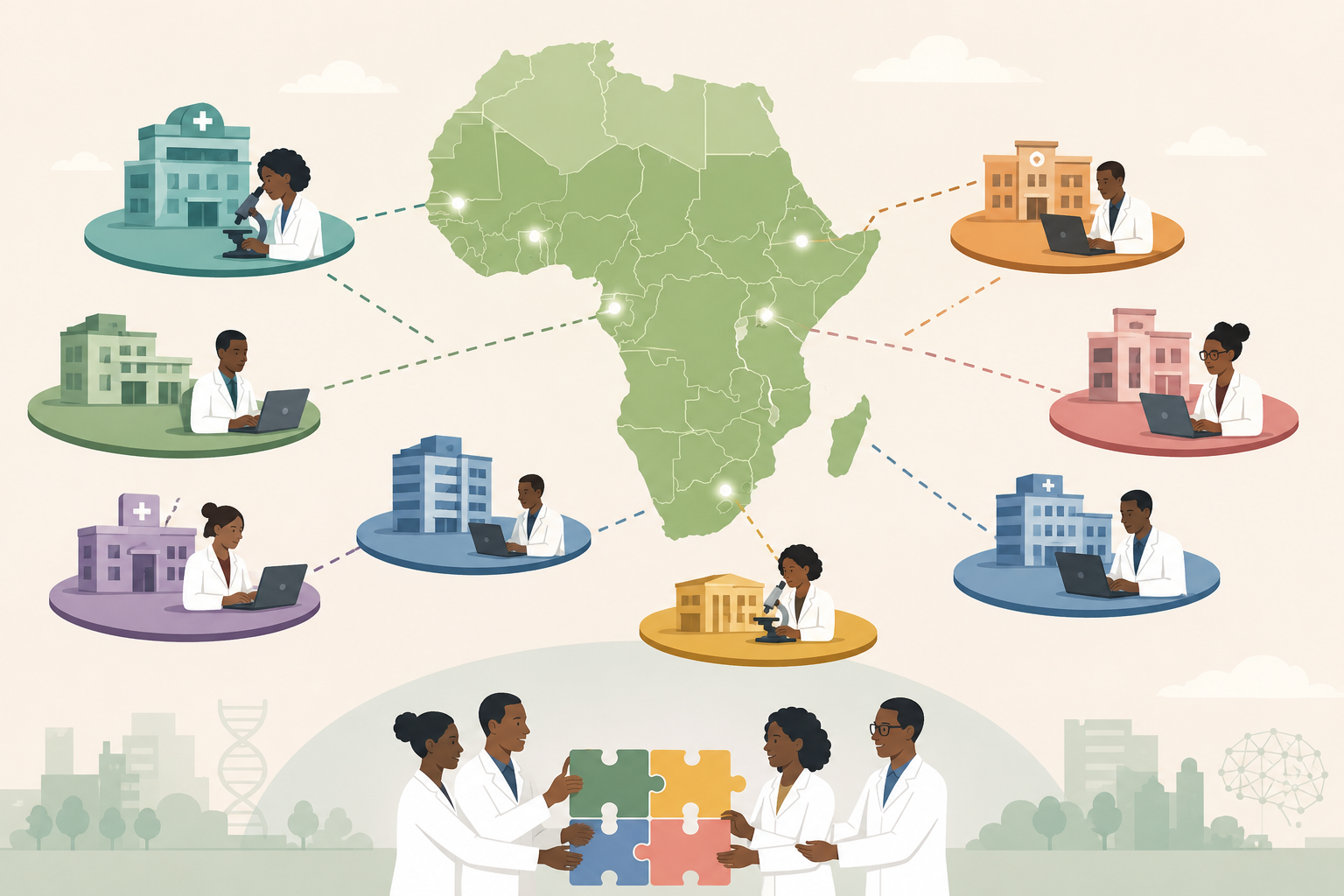
AI-powered diagnostic research is expanding across sub-Saharan Africa, but the institutions involved are working largely in isolation, limiting opportunities for knowledge sharing and capacity building, according to a new study published in The Lancet Regional Health – Africa.
Researchers analyzed all registered artificial intelligence diagnostic clinical trials conducted in sub-Saharan Africa up to November 2024 and found that while activity in the field is increasing, collaboration networks remain weak.
The study identified 11 registered AI diagnostic clinical trials across 10 countries involving 35 institutions. Most of the trials focused on tuberculosis, cervical cancer and diabetic retinopathy, with nearly three-quarters registered after 2020, reflecting growing interest in AI applications in healthcare.
However, the researchers found that the institutions involved in the trials were grouped into separate, disconnected networks.
“AI diagnostic clinical trial networks in sub-Saharan Africa exhibit complete structural fragmentation with no institutional bridging positions, suggesting limited cross-trial knowledge transfer despite active participation,” the study states.
According to the researchers, no institution served as a bridge connecting different trials, meaning lessons learned in one project are unlikely to be shared systematically with others.
“Network analysis revealed 11 disconnected components with uniformly zero betweenness centrality, indicating no institution occupied a bridging position between trials,” the authors wrote.
The study warns that the fragmented structure could hinder the development of a sustainable AI innovation ecosystem in Africa. Researchers noted that institutions working on different disease areas often face similar challenges related to regulation, data governance, validation of AI tools and community engagement, yet there is little evidence of collaboration across projects.
“This structural isolation creates missed opportunities for cross-trial learning,” the paper says.
While the findings suggest weaknesses in the current research landscape, the authors note that the field is still relatively young. They describe the AI diagnostic trial network as being in an “early formation stage with isolated rather than integrated innovation activities.”
The researchers recommend establishing cross-trial learning platforms, encouraging researcher exchanges and supporting regional research consortia to strengthen collaboration.
They also argue that efforts to build AI innovation capacity in Africa must go beyond funding individual projects.
“Building sustainable AI diagnostic innovation capacity in sub-Saharan Africa requires more than funding individual trials,” the study says.
The authors further call for stronger African leadership in AI research partnerships, arguing that local institutions should play a greater role in setting research agendas, governing data and sharing in the benefits of successful innovations.
IMAGE CREDIT: AI