
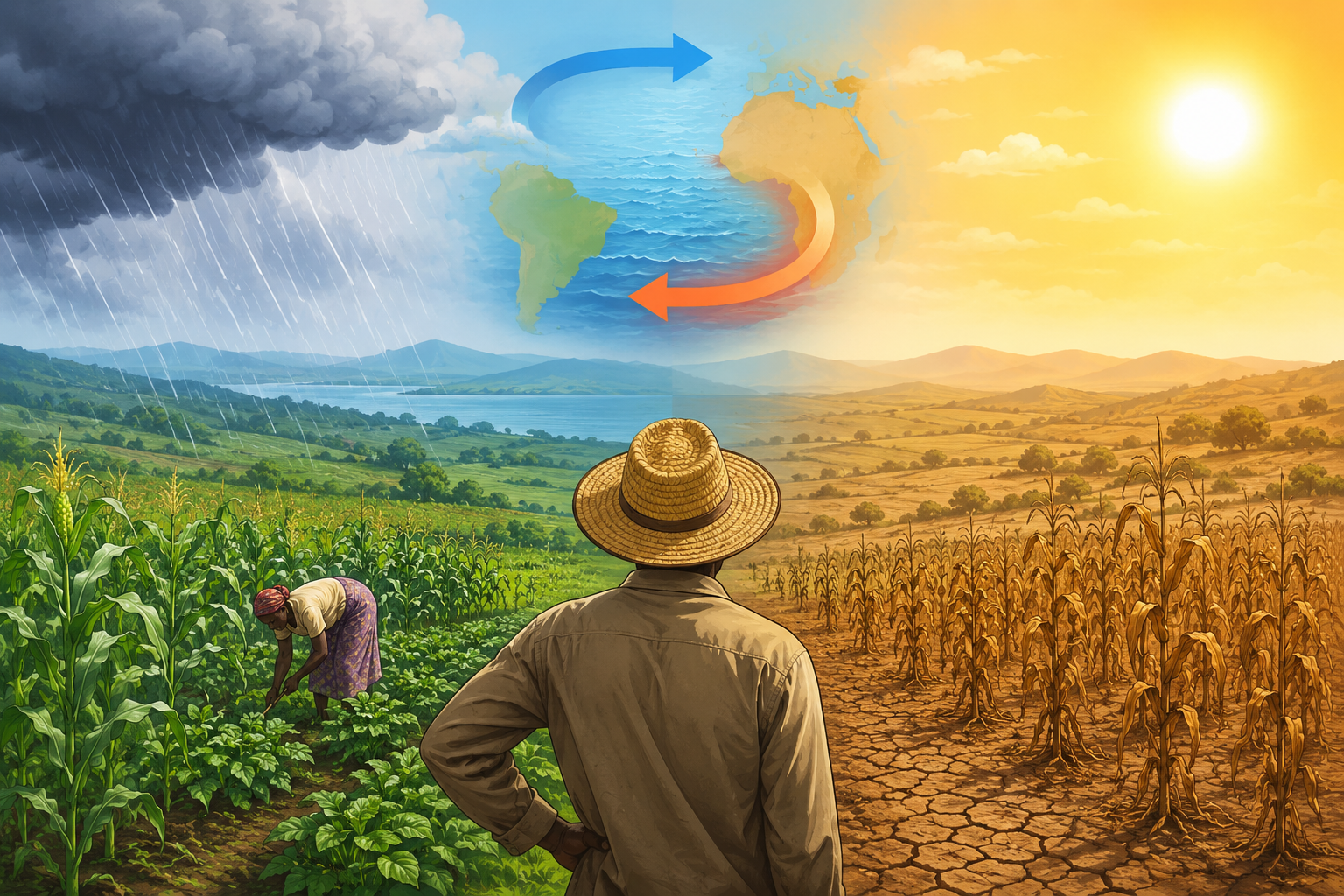
Heavy rainfall no longer guarantees better cereal harvests across Africa, with warming temperatures in the Atlantic Ocean reducing the benefits that farmers once enjoyed from wet seasons, a new study has found.
Researchers who examined more than six decades of agricultural and climate data from 52 African countries say long-term changes in North Atlantic Ocean temperatures are altering how rainfall influences crop production, particularly for staple cereals such as maize, wheat, millet and rice.
The study, published in Scientific Reports, found that before the mid-1990s, periods of high rainfall were much more likely to produce higher cereal yields across most of the continent.
“During a negative phase of the AMO (pre-1995), high precipitation levels significantly increased the likelihood of increased cereal yield in almost all regions of Africa, yet not during the positive phase of AMO (post-1995),” the researchers wrote.
The scientists focused on the Atlantic Multidecadal Oscillation (AMO), a natural climate cycle that alternates between warmer and cooler sea surface temperatures over several decades and influences rainfall patterns across Africa.
They found that while abundant rainfall boosted cereal production during the cooler phase of the AMO, those gains became much smaller after the Atlantic shifted into a warmer phase around 1995.
“Our results provide new evidence that the AMO significantly modulates the relationship between precipitation and yields across African regions, particularly for cereal crops,” the study said.
The researchers believe rising temperatures may be offsetting the benefits of rainfall by increasing evaporation and exposing crops to greater heat stress.
“The diminished yield benefits of high precipitation during a positive (warm) phase of the AMO may be due to reduced rainfall efficiency, increased evapotranspiration, and more frequent intra-seasonal dry spells that disrupt growth phases of rainfed crops,” they said.
The study found the effect was strongest for cereal crops, while fruit and vegetable yields showed much weaker links to the Atlantic climate cycle.
With Africa expected to face rising food demand in the coming decades, the researchers say their findings underscore the need to improve climate forecasting for agriculture.
Rather than relying solely on seasonal rainfall predictions, governments could incorporate long-term ocean temperature patterns into agricultural planning.
“Integrating decadal-scale ocean-atmosphere indices into crop forecasting systems could substantially improve early warning capacity and inform region-specific adaptation strategies in African agriculture,” the authors said.
The researchers cautioned that the study does not prove that changes in Atlantic Ocean temperatures directly cause fluctuations in crop yields. They noted that factors such as local farming practices, irrigation, soil conditions and other climate systems, including El Niño, also influence agricultural production.