
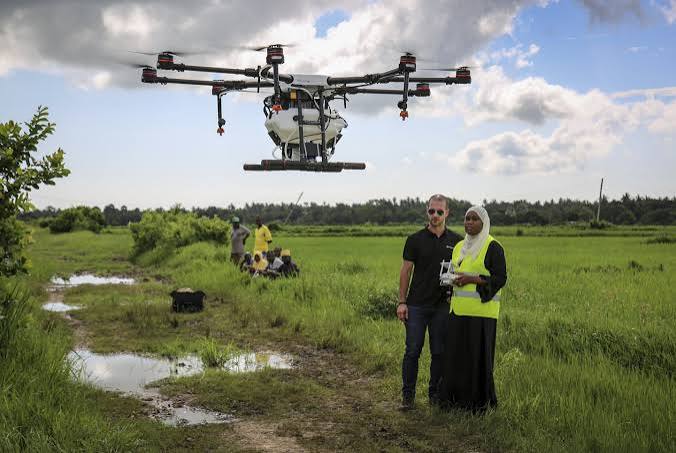
A new study has shown that drones and artificial intelligence (AI) can help identify thousands of hidden mosquito breeding sites across urban areas, offering public health officials a faster and more efficient way to combat diseases such as dengue, Zika, chikungunya and yellow fever.
Published in PLOS Neglected Tropical Diseases, the study focused on Dar es Salaam, Tanzania, where researchers combined high-resolution drone imagery with supervised machine learning to map containers that could serve as breeding habitats for Aedes mosquitoes—the primary vectors of several mosquito-borne viral diseases.
Traditional ground surveillance for mosquito breeding sites is often slow, labour-intensive and difficult to carry out in densely populated cities with informal settlements. To overcome these challenges, the researchers surveyed 20 neighbourhoods using drones while community workers simultaneously conducted field inspections for mosquito larvae.
The field surveillance found that Aedes larvae were most commonly associated with buckets and jerry cans, discarded tires and water storage tanks. These container types were then manually labelled in thousands of drone images to train an AI model capable of identifying similar objects automatically across much larger areas.
Using the trained model, the researchers analysed drone imagery covering more than 27 square kilometres of Dar es Salaam and detected over 135,000 potential mosquito breeding containers. The system achieved detection accuracies of 75% for water tanks, 72% for tires and 54% for buckets.
The study also uncovered breeding habitats that are difficult to detect during routine inspections on the ground.
“Drone images revealed rooftop tires, a container type likely overlooked during ground surveillance,” the researchers wrote.
According to the authors, discarded tires left on rooftops can collect rainwater and remain undisturbed for long periods, creating ideal conditions for Aedes mosquitoes to lay eggs. The drone imagery also identified rooftop water tanks and buckets hidden within enclosed household compounds that may otherwise escape detection.
Researchers observed that neighbourhoods with higher population densities generally contained more buckets and tires, suggesting these containers accumulate where more people live. Water tanks, however, were more common in areas believed to have higher socioeconomic status, indicating that different factors influence the distribution of potential breeding habitats.
The authors said the findings demonstrate the potential of emerging technologies to strengthen mosquito surveillance programmes.
“This study demonstrates the feasibility of drone imagery and supervised machine learning as a remote, scalable tool to map potential Aedes larval container habitats at very high resolution,” they wrote.
The researchers noted that the resulting maps could help guide field teams by directing them to areas with the greatest concentration of potential breeding containers.
“The resulting maps could guide ground-based larval surveillance and larval source management by highlighting areas with a high density of containers for further investigation,” the study states.
Although the maps identify potential breeding containers rather than confirming the presence of mosquito larvae, the researchers believe the technology could improve outbreak preparedness and make mosquito control campaigns more targeted and cost-effective.
“Public health agencies could integrate the density maps into routine surveillance workflows to prioritize field inspections, optimize larval source reduction campaigns, and allocate resources more efficiently,” the authors concluded.
PHOTO CREDIT