
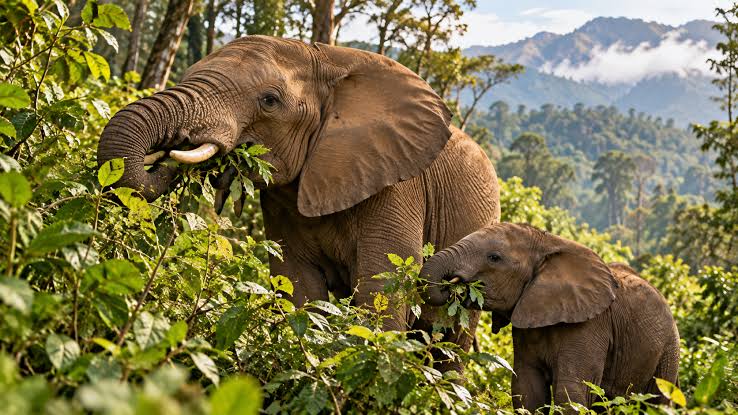
On the slopes of Mount Elgon, along Kenya’s border with Uganda, wildlife scouts and elders say they have watched elephants seek out particular plants when unwell and, they claim, dose their calves with them.
A new study in Scientific Reports records those accounts. Researchers led by Fabien Schultz and Elodie Freymann interviewed eight men from the Sabaot community between October 2023 and September 2024. Each had more than 20 years of experience around the local elephants.
Informants named 35 plant species from 23 families, plus four soils, clays or minerals. Of the 39 resources, 34 have traditional human medicinal uses, and informants called 25 of them medicine for elephants.
The most frequently cited plants, Croton macrostachyus and Ficus natalensis, were each named by five of the eight informants. Eight plants earned the strongest classification, “Mode 4”: medicines sought by visibly sick elephants or given to offspring. The authors say these reports suggest “targeted rather than random foraging.”
Informants said elephants combine leaves of Coleus barbatus, Ficus natalensis and Bersama abyssinica with their own milk and feed the mixture to calves. One interviewee described it as “a kind of immunization.” Another said mothers give Aloe arborescens to calves so they will eat, calling it “an appetizer.”
Three species of Dombeya were said to be eaten for their bark, which contains a slippery substance informants believe aids digestion and softens droppings. Another plant, Kuloa usambarensis, was linked to elephants showing visible signs of sickness, such as barely moving for days. Informants also said elephants sometimes seek out a resource in tiny amounts or travel far to reach it. “They go straight there without eating anything to get there quickly,” one said, although the authors note that remark was general, not tied to a single case.
The knowledge appears to flow both ways. Some informants said people learn from elephants. “Whatever works for elephants also works for us,” one recalled his grandfathers saying.
The authors are careful. Their sample was eight men, chosen as experts, not as a representative group. No one tracked individual animals, confirmed illness or showed that a plant helped. They also concede that informants may interpret elephant behavior through their existing medical knowledge. Clay and salt from the region’s caves, long suspected as medicine, were described by every informant as a source of minerals or simple enjoyment.
Most of the frequently cited plants have documented human uses and lab-tested activity, but elephants eat so many species that some overlap could be coincidence, and the paper does not test for that. The word “putatively” is in the title, and the paper calls for pharmacological testing and long-term behavioral studies.
Stronger evidence exists elsewhere. In Indonesia, a wild orangutan named Rakus treated a facial wound with a plant known for antibacterial and anti-inflammatory properties; it closed within days, according to a 2024 study in Scientific Reports.
In Uganda, research on Budongo chimpanzees found that plants eaten by ill or injured animals all showed anti-inflammatory activity, and most fought bacteria that are pathogenic to humans. The field’s foundation is a 1989 study of a sick chimpanzee eating Vernonia pith in Tanzania. Chimpanzees have also been seen applying insects to wounds, and researchers have proposed that Indo-Pacific bottlenose dolphins self-medicate with invertebrates on coral reefs.
For elephants, the record is thinner. Work in Thailand suggests Asian elephants eat plants that Karen mahouts also use, and a Gabon study asks whether crop raiding by forest elephants could be tied to self-medication, though that work also needs further research.
If the Mount Elgon reports hold up, the authors argue, elephants may have “more diverse and complex medicinal repertoires than previously recognized.” Because African elephants are endangered, protecting their habitat could also mean protecting the plants they may depend on.
Photo source