
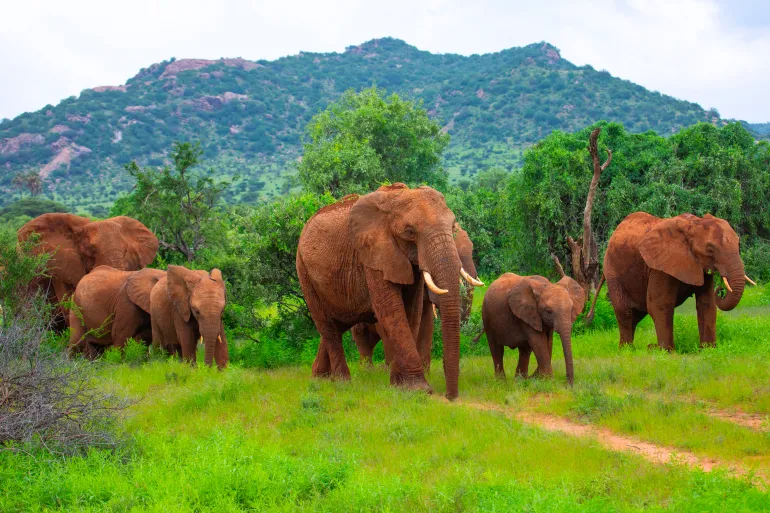
Elephants talk in rumbles too low for people to hear. When several rumble at once, researchers now say, the overlap is a message in itself.
The finding comes from a study published on 1 October in Scientific Reports. A team from Earth Species Project, ElephantVoices, the Amboseli Trust for Elephants and Colorado State University studied about 900 recordings of wild adult female elephants in Amboseli National Park, Kenya, made between 1986 and 2022. Observers noted what the animals were doing as each call was made.
The recordings came from a parked vehicle, usually with the nearest elephant 5 to 20 metres away. About half came from a single family of 28 animals that the team followed closely in 1999 and 2000, to catch the same voices again and again.
Why bother with choruses? Because they are everywhere. Earlier work, cited by the authors, found that “approximately 60% of elephant rumbles occur within choruses.” Yet most research on animal calls looks at one voice at a time. Overlapping sounds are hard to pick apart, a puzzle the paper calls the “cocktail party problem.”
The researchers sorted calls into six situations. Some were about logistics: calling to a separated relative, urging the group to move, trading calm remarks while feeding or resting. The others were affectionate: comforting a calf, greeting a close relative, a full reunion ceremony. Then they trained a computer to guess the situation from the sound alone.
It did better than chance, for single rumbles and choruses alike. For the best-studied family it got about 44% of single rumbles right, against roughly 19% expected by luck. Calls to reconnect with distant family were the easiest to spot. Still, the authors admit that “more rumbles were classified incorrectly than correctly”, since rumbles blend into one another and so do the moods behind them.
A second result mattered more. A model trained on single rumbles alone could still guess the situation behind choruses. So a chorus looks like a stack of matching calls. The authors write that “elephant choruses function as group signals encoding context.”
Next, the team followed how rumbles changed during an exchange among several animals. Calls less than three minutes apart counted as one exchange, and the analysis covered 92 of them, each with at least three rumbles and two or more callers. In three situations (reconnecting, calm back-and-forth, and reunion greetings) each rumble sounded a little more like the last. In the other three it did not, although some samples were tiny and the authors urge caution.
Convergence turned up mostly in long exchanges where callers were settling on what to do. The authors suggest its main job “may be to facilitate logistical coordination.” Parrots do something similar when flocks merge. So do people, who tend to pick up the speech habits of whoever they are talking to.
The model also stumbled on elephants it had never heard, and stumbled more across families. Every elephant has a voice of its own; families may add a faint accent. The data cannot yet say which matters more.
Earlier work from the same circle points the same way. A 2024 study in Nature Ecology & Evolution found that elephants address each other with calls specific to the individual, much like names. A 2024 paper in Royal Society Open Science found that group membership predicted call similarity better than genetic relatedness did, which hints that group differences are learned.
There are caveats. Observers judged each situation on the spot, and nobody independently rated the same calls, so agreement could not be checked. Some categories were small. Much of the data came from one family.
The authors also flag the “absence of playback experiments”, in which recordings are played back to elephants to see how they react. Future studies, they write, should use more families, video, and independent coders.
Image source