
Taking medicine every day is never simple. Then, imagine someone who has to take daily pills for years. That is what someone living with HIV has to do. It means remembering a pill every morning, carrying medication while travelling and worrying about other people discovering their HIV status.
These challenges can make it difficult to take treatment consistently, even when someone wants to stay healthy.
Scientists are exploring whether long-acting injections can make HIV treatment easier for some people. A new study involving adults in Uganda, Kenya and South Africa suggests this approach could be a useful alternative to daily pills.
Published in The New England Journal of Medicine, the study tested two HIV medicines, cabotegravir and rilpivirine, given as injections into the muscle every eight weeks.
The researchers enrolled 540 adults who were already taking HIV treatment and had achieved viral suppression. However, they had recently experienced difficulties taking their medicines consistently or staying engaged in care.
Participants were randomly assigned to receive either the injections or continue taking their daily, dolutegravir-based treatment. Researchers then compared how well the two approaches kept HIV under control over 48 weeks.
The results were encouraging.
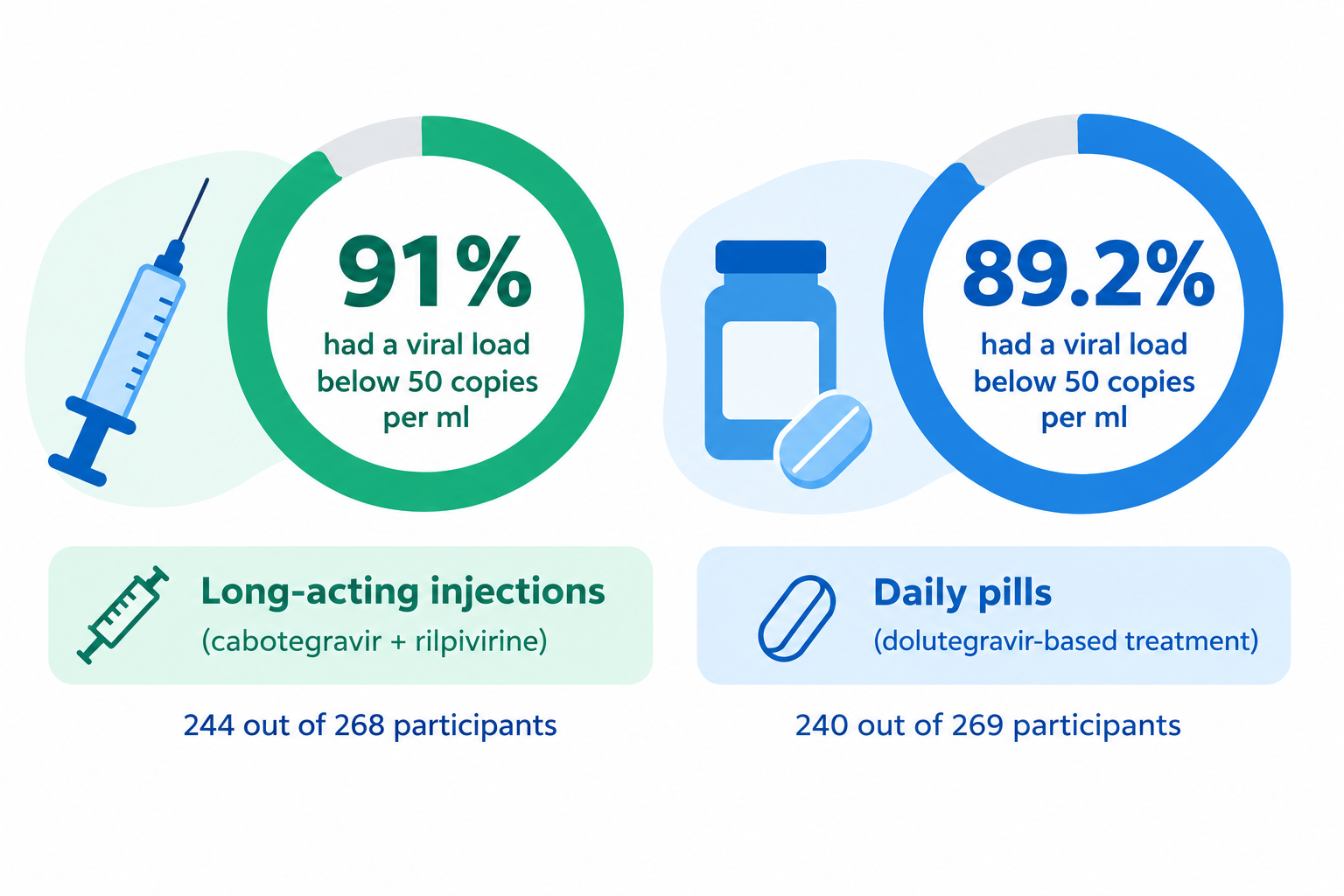
At the end of the study, 91% of participants receiving injections had HIV levels below 50 copies per millilitre of blood. The same was true for 89.2% of participants taking daily pills.
This means the injectable treatment performed about as well as daily oral treatment at maintaining viral suppression.
This matters a lot. Antiretroviral medicines work by controlling HIV in the body. When treatment is taken consistently and works effectively, the virus can be suppressed, protecting the immune system and helping people live longer, healthier lives.
But daily treatment can be challenging. In eastern and southern Africa, approximately one million people receiving oral HIV treatment have not achieved viral suppression because of adherence difficulties.
For some, injections can reduce the burden of remembering pills every day. They may also offer greater privacy and help reduce worries about HIV-related stigma.
However, injections are not a perfect solution.
Five participants in the injectable group experienced confirmed virological failure, compared with none in the daily-pill group. This means the virus was no longer adequately controlled in these participants.
About 37% of participants receiving injections experienced reactions at the injection site. These were mild or moderate and did not lead anyone to stop treatment. Serious adverse events occurred in 4.1% of the injectable group and 3% of the oral-treatment group.
There are also practical challenges. Patients must attend clinics on schedule, while health facilities need reliable medicine supplies, suitable storage and systems to monitor treatment and identify possible failure.
The study findings also have an important limitation: participants had already achieved viral suppression before joining the study. The results therefore do not establish that injections will work equally well for people whose HIV is currently not suppressed.
Nevertheless, this is an important study. The question now is how to introduce long-acting treatment into routine healthcare, determine who would benefit most and ensure it remains affordable and accessible.
QUOTE OF THE WEEK
“Hundreds of children have died of starvation and disease in a drought in Sudan caused by the record-breaking El Niño. The risk of this leading to a full-blown famine is growing,” New Scientist
RESEARCHHIGHLIGHTS
Iron Deficiency, Malaria Drive Anaemia in Madagascar: More than four in 10 preschool children in Madagascar have anaemia, with iron deficiency and malaria major contributors, a nationally representative survey has found. Iron deficiency was the leading contributor among preschool children and menstruating women, while malaria dominated among adolescent boys and girls, highlighting the need for targeted nutrition and malaria-control interventions. [Journal: The Lancet Regional Africa]
Parasitic Worms Infect 42% of Adults in Rural Cameroon: A study found that more than four in 10 adults tested in rural Cameroon had parasitic worm infections. The infection rate was 41.9%, and the study detected river blindness in 23.9% of participants. Researchers said adults may sustain parasite transmission despite decades of preventive treatment targeting children, calling for expanded treatment coverage and stronger public awareness. [Journal: PLOS Neglected Tropical Diseases]
Togo Counts 1,521 People With Albinism: Togo’s first national survey identified 1,521 people with albinism, finding that 70.7% faced daily sun exposure without adequate protection. More than 30% reported albinism-related health problems, while only 37% had regular medical follow-up. The study also found that 61.6% had no regular income, highlighting the need for better healthcare access and protection against skin cancer. [Journal: PLOS ONE]