Have you ever wondered where all the water used across Africa goes?
You may think about the water we drink, use to cook or collect for household chores. However, millions of litres are also needed to grow our food, generate electricity, manufacture products and extract minerals.
A new study published in Nature has attempted to map these demands across Africa. It estimates that the continent needed about 347 billion cubic metres of water in 2020.
That is a lot of water. And the biggest consumer is agriculture.
Farming takes the biggest share
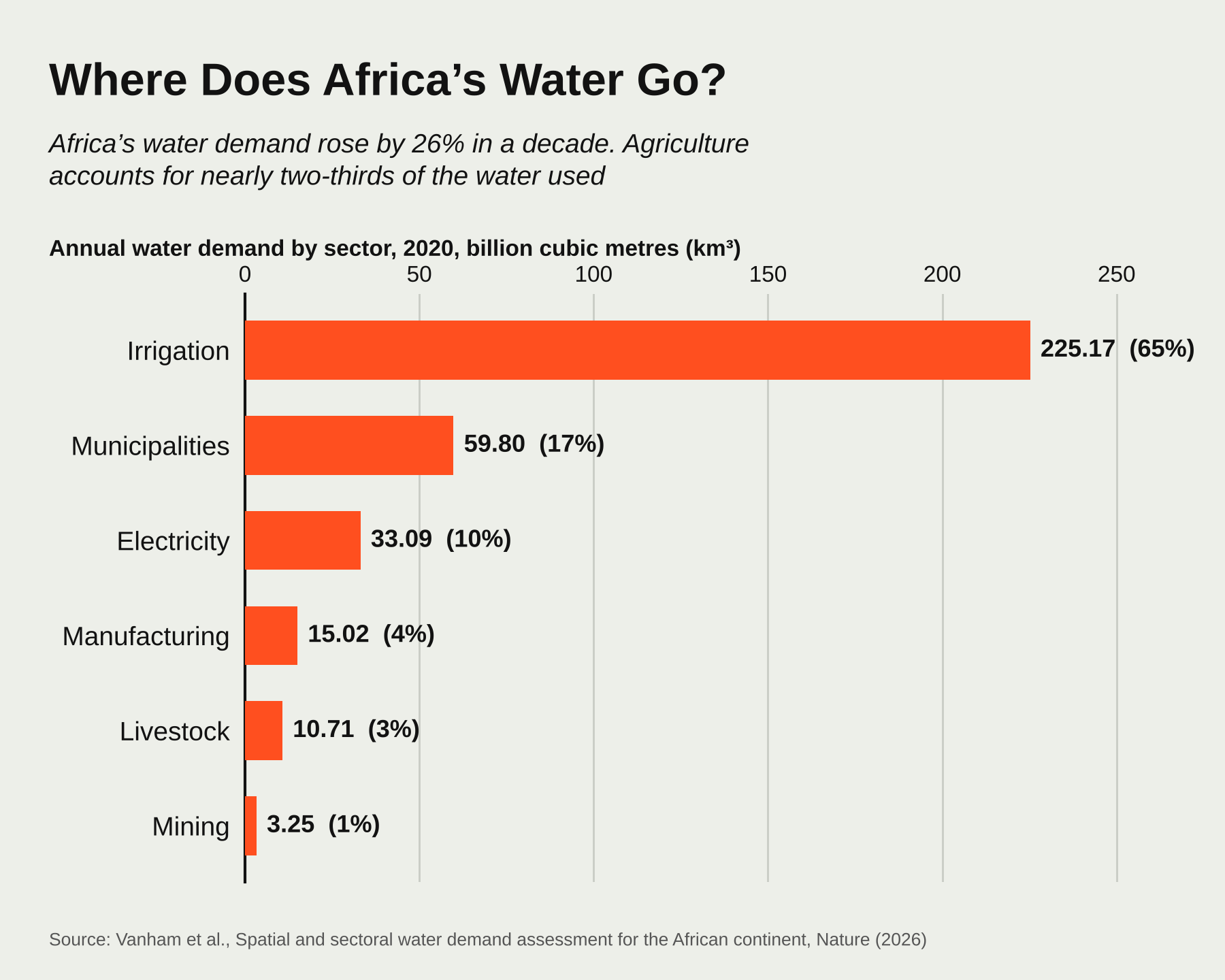
Researchers estimate that irrigation accounted for 225 billion cubic metres of water, or 65% of Africa’s total water demand in 2020.
Households and communities accounted for another 60 billion cubic metres, representing 17%. Electricity production, including hydropower, required 33 billion cubic metres (10%), while manufacturing used 15 billion cubic metres (4%).
Livestock and mining accounted for 11 billion and three billion cubic metres, respectively.
The findings show how closely Africa’s water needs are tied to food production. As demand for food and other goods grows, so does the pressure on the water needed to produce them.
Demand is growing
The study found that Africa’s total annual water demand increased by 26% between 2010 and 2020, rising from about 275 billion to 347 billion cubic metres.
But this pressure is not the same everywhere.
Researchers found that parts of North and Southern Africa face water demand that exceeds available water resources. “Water scarcity is now concentrated in the dry areas of North Africa and southern Africa.”
Water nearby, but not at home
One of the study’s key findings concerns access to piped water.
In 2020, an estimated 642 million Africans had access to piped water, while 717 million did not. That means more than half of the continent’s population lacked piped water access.
This can happen even in places where the amount of water available is greater than the total demand.
As the researchers explain, “physical availability alone does not determine water security”.
A river or lake may contain plenty of water, but without treatment facilities, pipes and reliable distribution systems, communities may still struggle to get safe water.
The hidden water cost of the energy transition
Mining is another area to watch. The researchers estimate that water demand from mining increased by 65% between 2010 and 2020.
Cobalt mining recorded an especially sharp increase, with demand rising by almost 500%, particularly in the Democratic Republic of Congo. This was driven partly by growing global demand for cobalt, which is used in electric vehicle batteries.
This raises an important question: as the world looks to minerals from Africa to support the transition to cleaner energy, how will countries manage the water needed to extract them?
The researchers say governments need to consider the water demands of different sectors when planning how to use available resources. They point to the importance of improving water efficiency, reducing losses, investing in water infrastructure and exploring options such as wastewater recycling and desalination.
Read full newsletter