
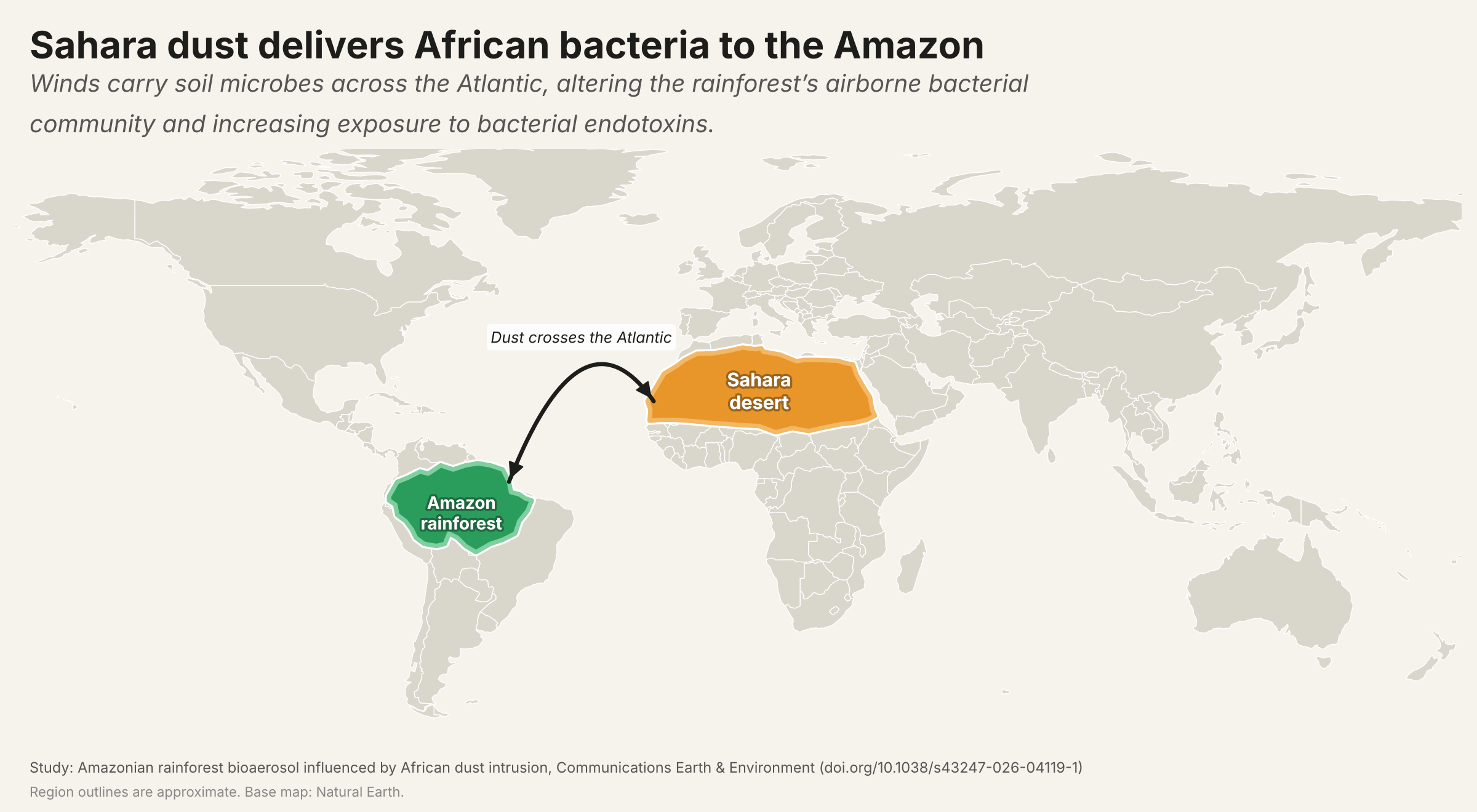
Dust blown from North Africa can carry bacteria across the Atlantic Ocean into the Amazon rainforest, changing the composition of microorganisms in the air, a new study has found.
The research, published in Communications Earth & Environment, found that dust transported from Africa introduced bacteria associated with dry soils and biological soil crusts into the atmosphere above the Amazon rainforest in Brazil.
“Genetically, the bacteria match organisms from the Sahara, which proves that they are transported from African biocrusts across the Atlantic by wind all the way to Brazil’s rainforest,” said Bettina Weber of the University of Graz, one of the study’s researchers.
The researchers collected air samples at the Amazon Tall Tower Observatory (ATTO), a research station surrounded by primary rainforest. Sampling took place over approximately three weeks in February and March 2020, at heights of 42 metres and 323 metres above the ground.
They identified a North African dust intrusion lasting five days, from February 18 to 22. Atmospheric trajectory analysis suggested that the dust had travelled from Africa to South America over approximately 10 days.
By analysing genetic material in the samples, the team found that the dust significantly altered the bacterial communities in the Amazon’s atmosphere. Bacteria associated with dry soils and biological soil crusts appeared alongside microorganisms normally found in the rainforest. Some marine-associated material may also have entered the air as dust crossed the Atlantic.
The researchers also detected a substantial increase in airborne endotoxins during the dust event. At the higher sampling level, concentrations rose from an average of 0.45 to 1.27 endotoxin units per cubic metre.
Endotoxins are components of the outer membranes of certain bacteria. When inhaled, they can trigger inflammatory responses in the body. The researchers note that the concentrations observed fall within ranges associated with respiratory, cardiovascular and cerebrovascular inflammatory responses.
“I was surprised by the large amount of endotoxins in the air,” said Jens Weber, another researcher involved in the study.
However, the researchers found that the African dust did not generally increase the abundance of bacterial groups containing organisms associated with vertebrates or potential human pathogens. Some of these groups were actually more abundant during periods without the dust intrusion.
The study also found that the fungal community in the air remained largely unchanged. The researchers suggest that the large quantities of fungal spores released by the rainforest may have masked any contribution from African dust.
The findings provide evidence that dust travelling across continents can influence the biological composition of the atmosphere far beyond its source. They also raise questions about how long-distance dust transport affects ecosystems and human exposure to airborne biological material.
However, the researchers caution that identifying bacterial genetic material does not establish whether the organisms were alive, active or capable of causing infections after travelling across the Atlantic. Further research is needed to establish the health and ecological consequences of these dust events.