Some diseases are new. Malaria is not one of them.
Scientists tracing its origins have found the parasite embedded in the human story for millennia. Evidence of it has been found in the mummified remains of Tutankhamun, and its shadow appears in medical texts written in ancient Greece, China, and India. Long before anyone understood what mosquitoes actually did, people were documenting its fevers.
We have had thousands of years to fight back, and dozens of drugs to show for it: quinine, chloroquine, sulfadoxine-pyrimethamine, and today’s frontline artemisinin-based combinations, each one a small victory in a war that never actually ends. Because malaria doesn’t lose. It adapts. Every drug that has ever worked against it has eventually encountered a parasite that learned to survive it.
That adaptability is the real reason malaria remains unbeaten. The parasite itself cycles through the liver and bloodstream, mutating as it goes. The mosquito that carries it evolves too, shrugging off insecticides and shifting its biting hours to slip past bed nets. Beat one, and the other still has ground to cover.
Nowhere absorbs the cost of that stalemate more than Africa. The continent accounts for roughly 95% of the world’s malaria deaths, and about three-quarters of those who die are children under five. Uganda alone contributes one of the highest numbers of malaria cases on the continent.
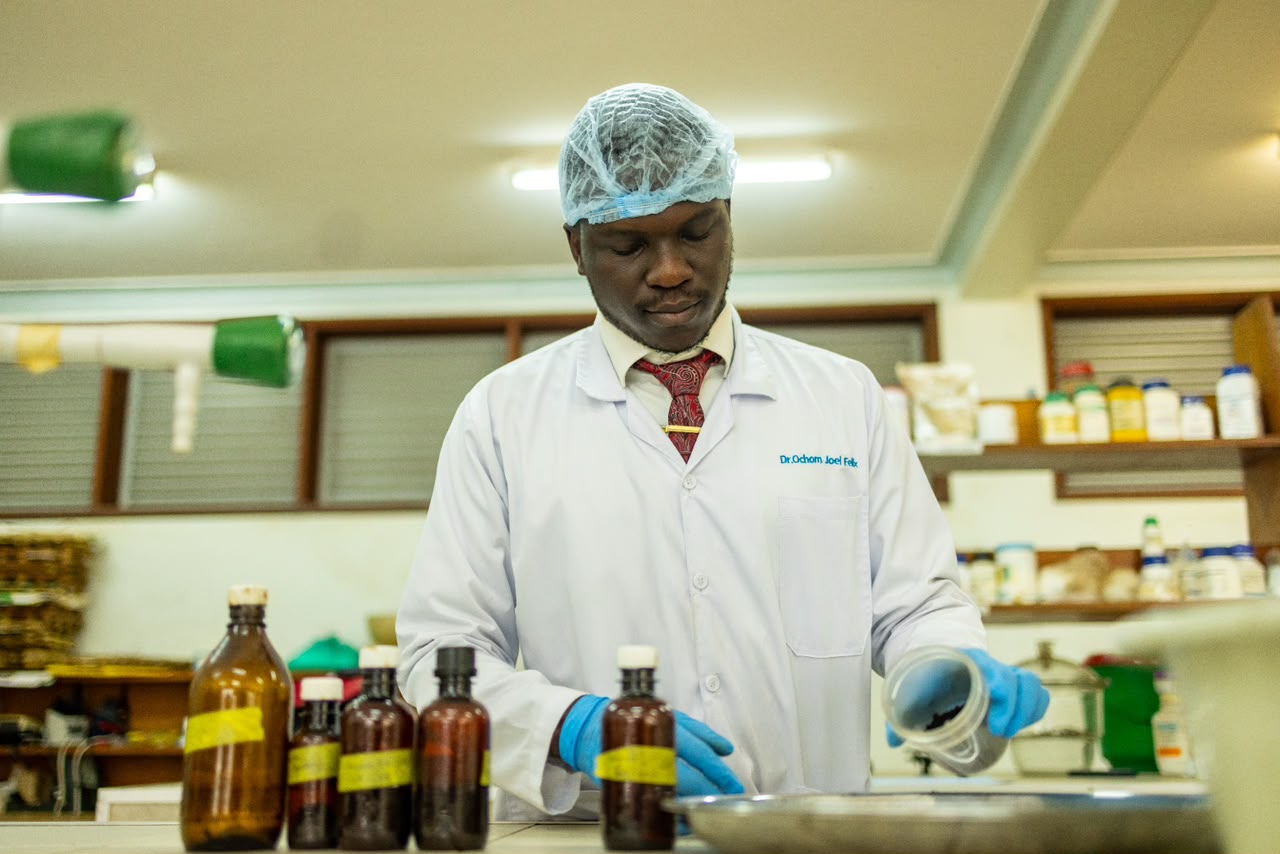
Joe Felix Ochom, 24, who grew up in eastern Uganda, is part of that statistic.
“Being from those areas, mosquitoes were usually rampant, and in my childhood, I really suffered from malaria,” he says. “I was one of the victims.”
Ochom, a pharmacist and innovator who recently graduated from Makerere University, doesn’t want to remain a malaria statistic. He is trying to become part of the answer.
Since joining the university, he has been working to develop Maisha, a plant-derived antimalarial candidate. The drug has gone through several stages of testing and, according to Ochom, is awaiting approval from Uganda’s National Drug Authority.
At university, he chose to study pharmacy because he felt it was the field of medicine where his creativity had room to breathe. When he joined pharmacy school in January 2022, he approached a lecturer with an ambitious idea: he wanted to develop a cancer treatment. But the lecturer advised him that developing a cancer vaccine would be extremely complex. Instead, Ochom was encouraged to focus on one of the most common diseases.
That was the nudge that sent him back to his own childhood.
“I recalled my childhood disease, which was malaria,” he says. “I started doing research about it immediately after I joined pharmacy school.”
What followed was two years of unglamorous, methodical work. Working with a fellow student, they screened around 20 plant species, eventually narrowing them down to 16 different drug combinations before settling on the formulation that would become Maisha, a Kiswahili word meaning “life.”
“We chose to call it Maisha because this is going to save a number of lives,” he says.
Why does he believe it could work where other treatments have failed? The answer lies in how the parasite itself behaves and how Maisha was deliberately designed to outmaneuver it.
Rather than attacking malaria at a single point of weakness, the formulation was designed to target the parasite at several stages of its life cycle at once.
Ochom describes the logic with a vivid comparison: “It’s like when you’re fighting someone and restraining them—someone will handle the hand, someone will handle the legs,” he says. “So even if they resist, maybe one hand has resisted, there’s someone holding the leg.”
The idea is that if the parasite mutates its way past one line of attack, another is already positioned to catch it.
The early results have encouraged him. In laboratory testing, Maisha proved effective against drug-resistant strains of the parasite. In animal trials, infected rats given the treatment recovered, while untreated controls did not. Separate toxicology testing found the formulation to be safe across major organs, with only a minor effect on red blood cells.
Ochom’s team also ran what is known as a prophylactic test, checking whether the drug could prevent infection altogether, rather than simply treating it.
“Even once someone is taking this medicine… if a mosquito bites you, you can’t get malaria,” he says of the results. “That’s when you’ve been taking it before the mosquito has bitten you.”
Maisha is still several steps away from a pharmacy shelf. It has undergone laboratory and animal-safety testing and is now moving through Uganda’s National Drug Authority approval process.
But there will be more hurdles before the drug can reach pharmacy shelves across the continent. Each African country requires its own regulatory review, meaning approval in Uganda would not automatically clear the drug for use in Kenya, Nigeria, or elsewhere.
Still, the project has already earned recognition, including Uganda’s Heroes in Health Award, a Global Student Entrepreneurship Award, and international attention through health-innovation competitions.
Throughout the project, Ochom and his team have received support from the Makerere University Research and Innovation Fund (MAK-RIF), Makerere University Innovation Pod (UniPod), among others.
Read the full edition of the newsletter.