
Weak enforcement, corruption, conflict and cross-border smuggling continue to fuel the trade in threatened Afzelia wood despite international restrictions.
KAMPALA: Inside the 2,000-acre Namanve Industrial Park – Uganda’s largest industrial hub, located about six kilometers from the capital – machines hum as factories manufacture goods, ranging from iron and steel products to plastics and beverages. Large trucks move in and out, delivering imported containers and picking up exports, adding to the noise and congestion on surrounding roads.
But there is one unusual product in the industrial park: hardwood timber – specifically Afzelia africana, commonly known as African mahogany, and Tectona grandis, commonly known as teak. Some of this wood comes all the way from South Sudan, despite international trade controls that have restricted commercial trade of Afzelia africana since February 2023. From South Sudan to Uganda, the timber is processed, loaded into containers and shipped to destinations as far as India, Vietnam and other countries, traders say.
While Uganda is a signatory to CITES – an international agreement that restricts trade in threatened plant and animal species, including Afzelia africana – South Sudan is not. Ugandan authorities argue that the country is simply facilitating trade on behalf of South Sudan in a species now considered endangered.
However, that narrative is undermined by the secrecy surrounding the trade, the reluctance of government officials to provide information, and evidence that brokers are selling documents on the black market that are meant to enforce strict trade controls. In South Sudan, economic pressures, corruption and poor enforcement of forestry laws are enabling illegal logging.
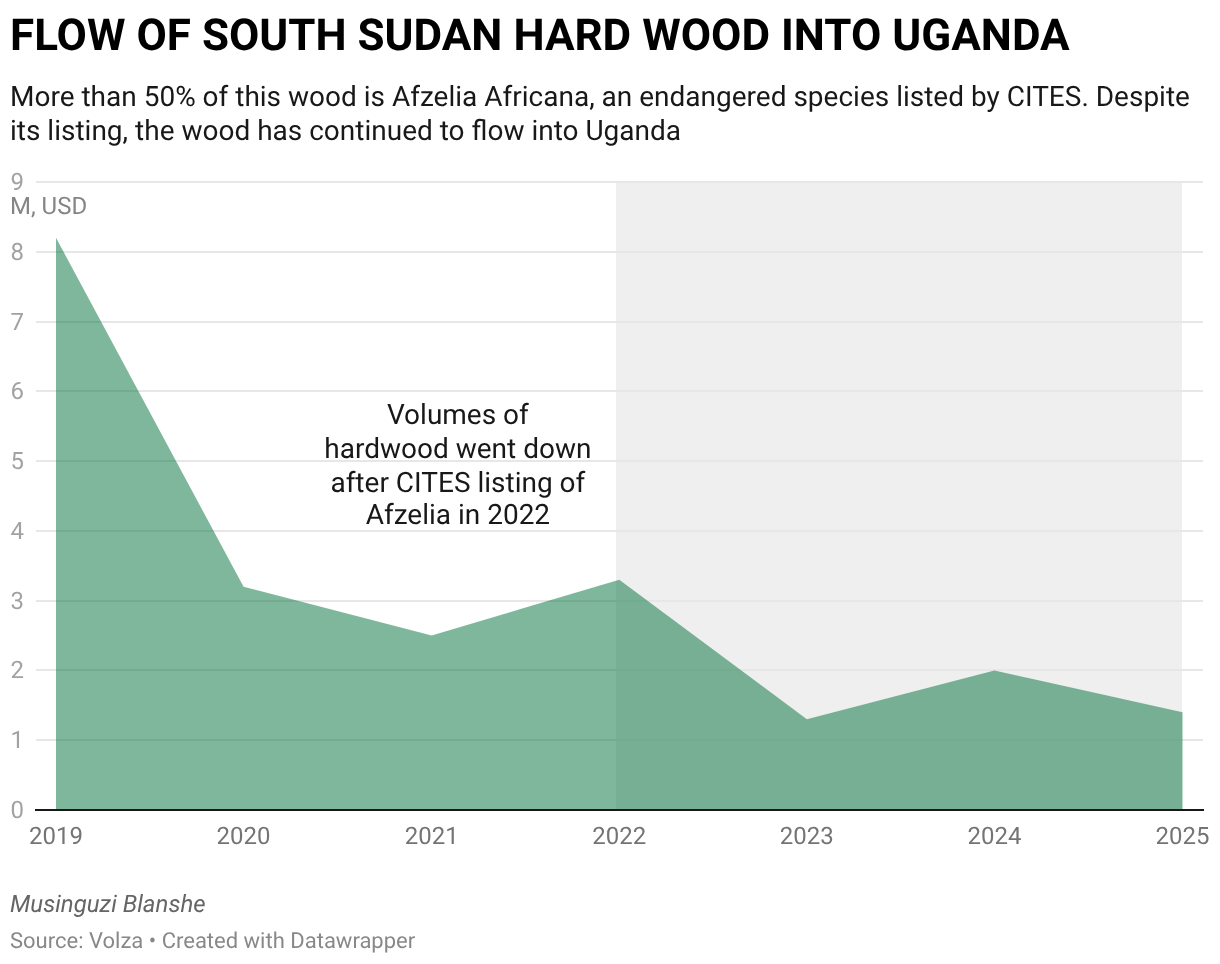
Precise data is difficult to obtain. However, trade records accessed from Volza, a global trade database, show that hardwood imports from South Sudan to Uganda were worth approximately US$23 million between 2019 and 2025. Afzelia africana accounted for roughly half of these imports.
Trade volumes declined during the COVID-19 pandemic and fell again after Afzelia was listed under CITES in February 2023. But the trade did not cease altogether. Customs records collected by Volza show that Afzelia worth at least US$3.4 million entered Uganda from South Sudan between 2023 and 2025, following the implementation of global trade restrictions.
Afzelia africana is listed under CITES Appendix II, which mandates countries to conduct a rigorous scientific assessment of the species and confirm its export will not threaten the species’ survival.
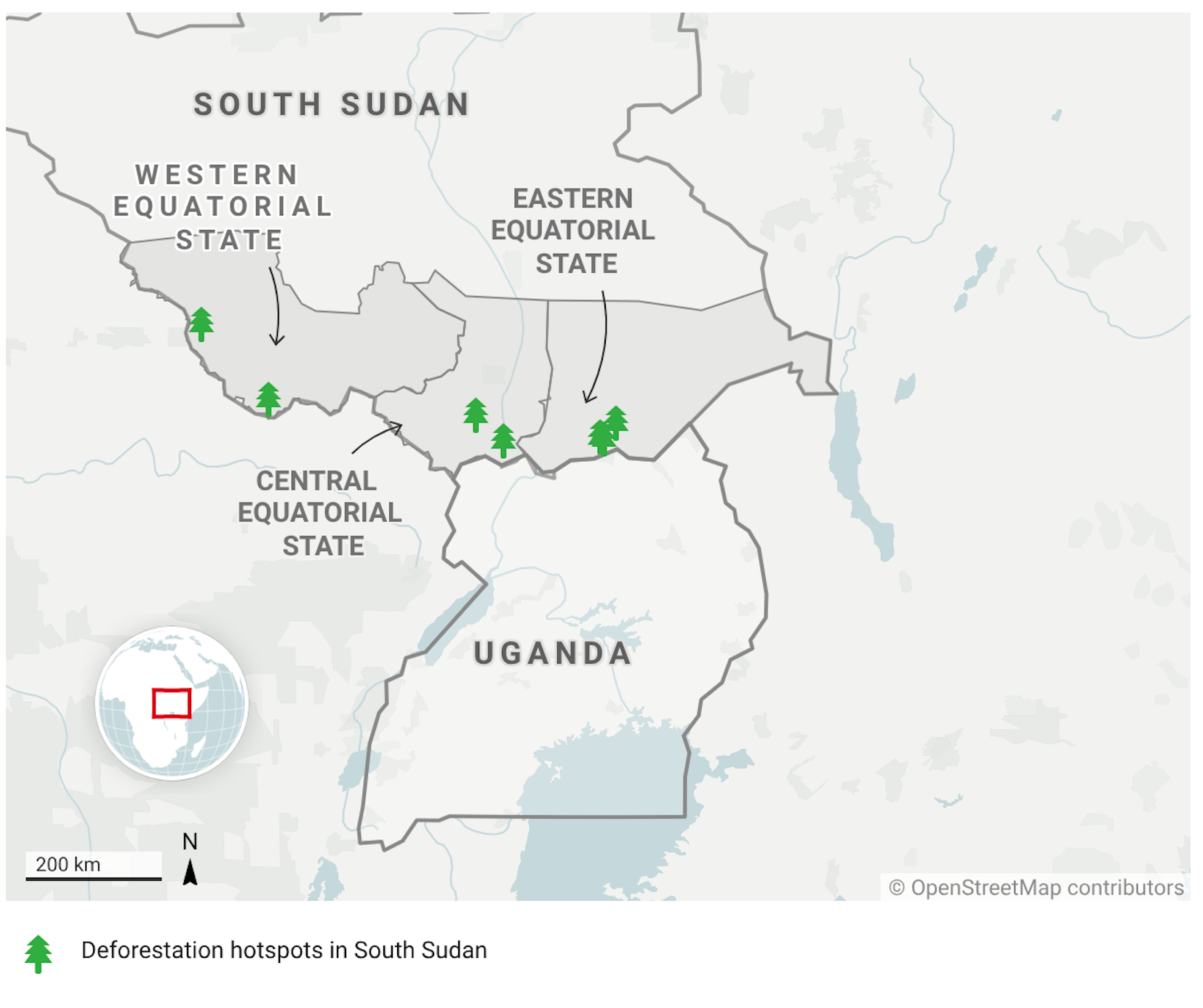
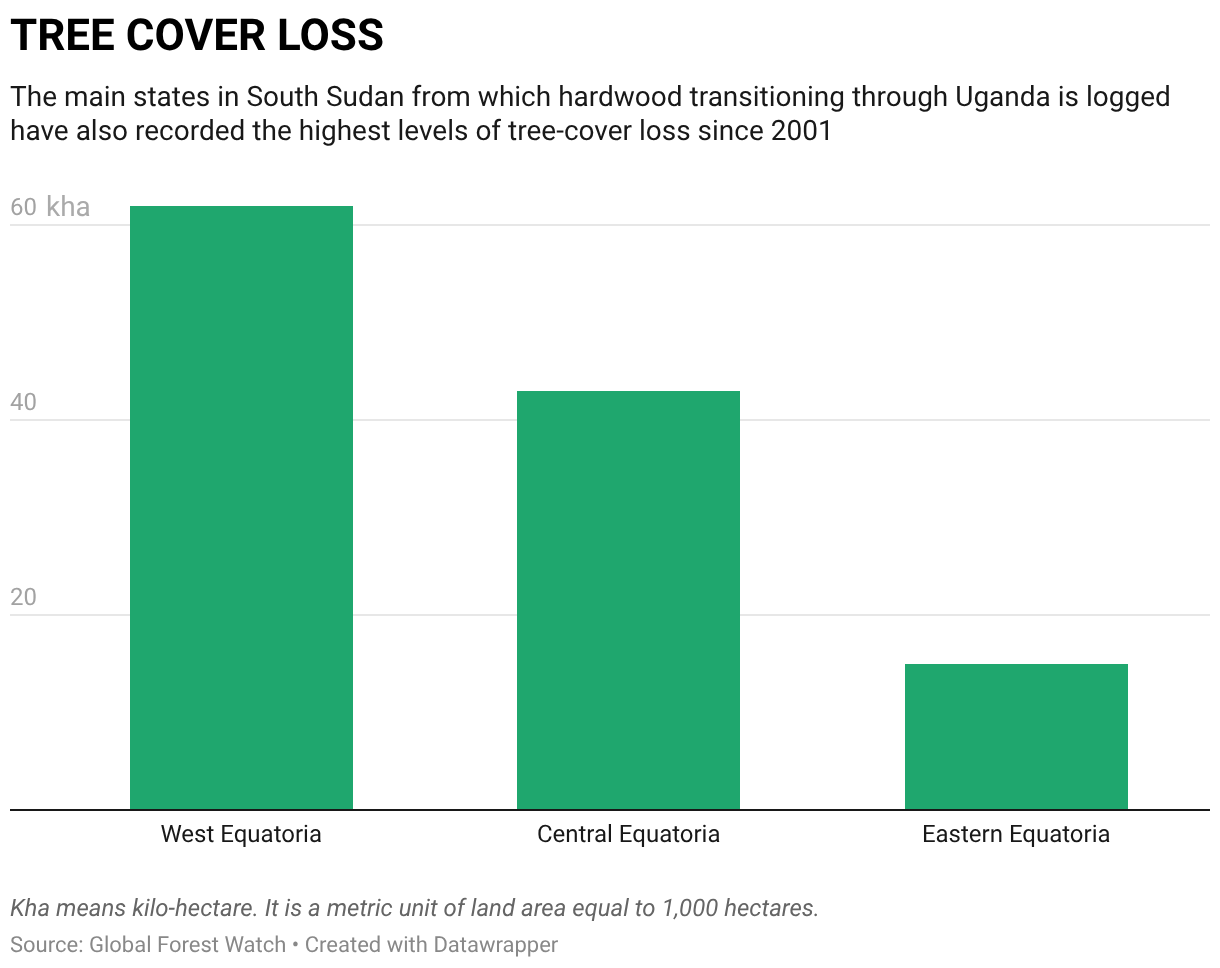
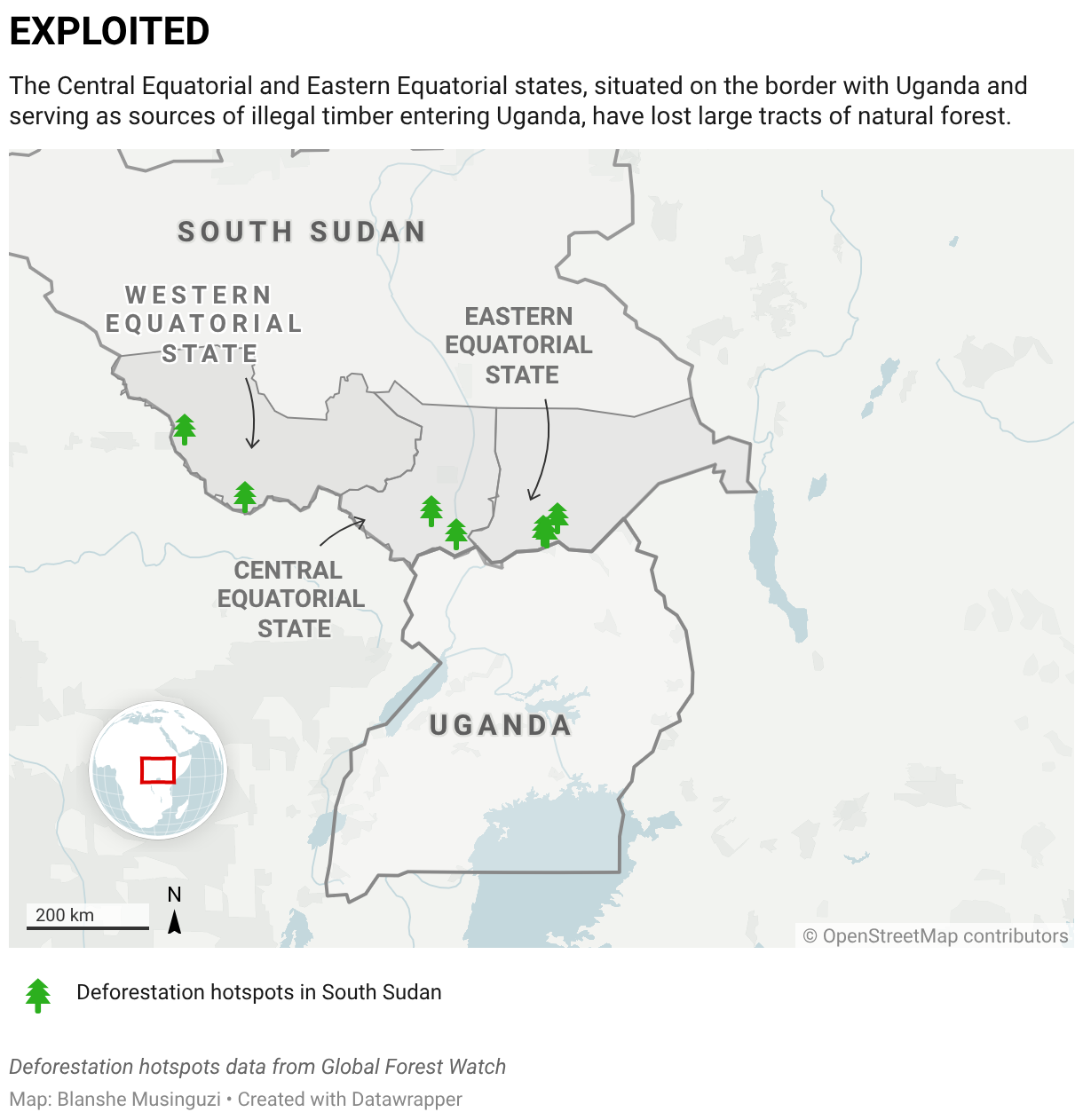
But according to Global Forest Watch data, the rate of natural forest loss has been increasing in South Sudan since the turn of the century. This is particularly evident in South Sudan’s Equatoria region: the southern area of the country, where most timber is logged that is exported to Uganda. This region faces increasing forest loss – the permanent conversion of natural forest to other land uses – with West Equatoria bearing the largest share. In 2020, the state had seven million hectares of natural forest covering 89 percent of its land area, but it lost 4,700 hectares of natural forest in 2025 alone.
Another measure that can imply forest vulnerability is tree cover loss, which is the removal of trees for any reason, including temporary ones. Between 2001 and 2025, the three Equatorial states have lost about 120,000 hectares of tree cover, underscoring growing pressure on South Sudan’s forests, partly caused by logging.
South Sudan is one of the most corrupt countries in the world, with a weak central government that does not fully control all territories. The country lacks strong regulatory frameworks to protect its forests. It still operates under the Forests and Renewable Natural Resources Act, which was enacted in 2002, before the country became independent. As a cash-strapped state that often struggles to pay civil servants, many individuals turn to forest exploitation for survival.
“Our country is going through serious economic hardship. Because of this, the forests of South Sudan have become highly vulnerable. Trees are increasingly seen as a source of income by those in power,” said Kor Chop Leek, an environmentalist at the Sudd Environment Agency, an NGO based in Juba.
William Leslie Amanzuru, an environmentalist and team leader at Friends of Zoka, said that several unofficial border points along the Uganda-South Sudan border are used to smuggle timber into Uganda. This was echoed by Emmy Mitala, a Resident District Commissioner (RDC) of Koboko, a northern border district of Uganda. He said charcoal is also entering, both legally and illegally. Some of the wood and charcoal comes from areas under control of rebel groups.
“Since April last year [2025], there has been a war [in South Sudan]. Sometimes, you hear it’s there [timber entering illegally], sometimes you hear it’s not there,” Mitala said. Ongoing fighting across several parts of the country was triggered by the arrest last year of Riek Machar, the vice president, by factions loyal to President Salva Kiir Mayardit.
Uganda banned Afzelia africana harvesting in 2017 in an attempt to curb illegal logging in Zoka, a forest in northern Uganda near the border of South Sudan and the DRC. Despite the ban, illegal logging continued, with traders reportedly cutting logs in Uganda, transporting them into South Sudan, and then re-importing them with falsified documentation indicating the timber originated there.
According to Issa Katwesigye, Assistant Commissioner for Forestry at Uganda’s Ministry of Water and Environment, the most significant impact of the 2023 CITES listing has been a reduction in the volume of Afzelia wood entering Uganda, mainly from a decrease in re-imports from Zoka. “The volumes of trade have gone down by more than 50%,” he said, referring to shipments of Ugandan wood claimed to originate from South Sudan.
However, traders, experts, and officials interviewed for this report said the listing has not eliminated illegal logging in Uganda – it has only slowed it down.
Amanzuru said the ban has transformed the trade. “It shifted the business from being accessible to ordinary people into a militarised enterprise,” he said. “To operate, you either have to be in the military or be backed by someone who is in the military.”
He added that transporting logs to Kampala, Uganda’s capital city, has become increasingly difficult due to numerous checkpoints. “It is impossible to move timber without being arrested,” he said.
Loggers exploit system gaps
Dominic Siricio Iru, Acting Director General for Forest Utilization and Forest Industries at South Sudan’s Ministry of Forestry, said weaknesses of logging governance are being exploited by loggers and traders.
By law, South Sudan is not supposed to log or export Afzelia, he said, except under very limited circumstances. However, due to weak systems, loggers often obtain permits to cut these trees from state authorities, bypassing national approval processes.
“There is a conflict in the approval of forest products. While we are supposed to approve these matters, states are issuing approvals for their own reasons. This is a significant challenge,” Iru said.
There are no clear procedures governing how states authorise logging. As a result, his directorate sometimes ends up facilitating exports that were approved locally – even though, as he emphasised, “for Afzelia, we do not grant approval.”
In some cases, exporters claim ignorance after cutting wood and applying for export permits. “Under very specific conditions, we might issue a certificate,” he said.
Iru also pointed to foreign influence, noting that governors sometimes bring in companies – often from Uganda – and approve logging, with exports routed through neighboring countries.
On the Ugandan side, Katwesigye, the assistant forestry commissioner, said traders “have to look for the proper documents” to import wood from South Sudan.
But an environmental crime and illicit financial flows expert found evidence that these permits are being illegally sold for $2,500 in Uganda.
This expert, who requested anonymity because of the sensitivity of the subject, approached a timber company in Kampala posing as a client in February and said the dealer was quick to offer a deal to acquire documents used to transit timber through Uganda.
Most of the companies driving this trade are difficult to trace. Data accessed from Volza lists several companies involved in the trade, but we were only able to verify three in company registration databases: Green World Investment Co Ltd, which is registered in South Sudan and exports Afzelia to Uganda, and Clintwood General Traders Ltd and Roheel Timber Co. Ltd, which are registered in Uganda and export Afzelia to global markets.
We were unsuccessful in our attempts over several months to get responses from the governors of Central Equatorial and Eastern Equatorial states, where much of the wood that comes to Uganda is logged.
Lona Nalurit Darius Gore, the official in South Sudan responsible for issuing movement permits, also did not respond to questions. On the Ugandan side, George Owoyesigire, Commissioner for Wildlife Conservation at the Ministry of Tourism, Wildlife and Antiquities, whose office is responsible for issuing permits, did not respond to requests for information despite submitting a written request to his office
Patrick Ongier, a Ugandan timber trader and director of Clintwood General Traders, which was among the key importers of wood from South Sudan until last year, said that powerful local authorities in South Sudan continue to enable logging without following the permitting system.
“Governors still have significant authority,” he said, adding that they offer permits without consultation with the ministry, which is supposed to issue permits.
Katwesigye from Uganda’s Ministry of Water and Environment argued that Ugandan authorities cannot reject documentation presented by traders if it matches the official requirements provided by South Sudan. He explained that once guidance has been issued on what constitutes valid documentation, and traders present those same documents, there is little basis for officials to dismiss them as illegitimate.
“If they have given us guidance on the official documents, and people present them, then on what grounds do we say this is not right, yet it is what we asked for?”
A logger’s testimony
Ongier – who spent more than a decade in Afzelia trade, importing wood from South Sudan and exporting it from Uganda – said widespread lawlessness allowed logging to thrive.
He described spending months in South Sudan’s remote forests, including areas controlled by rebels, cutting Afzelia trees and transporting them to Kampala. From Kampala, he would sell the wood to buyers in other countries, mostly Vietnam.
Past reports, including from the United Nations, have documented timber trade in rebel-controlled areas as a contributing factor to conflicts in the country. Ongier, however, said he could not verify whether he dealt with rebels. “When you are deep in the forest, you cannot tell who is a rebel and who is not,” he said.
His company often acquired trees through barter with local communities. “They would say, ‘bring goats, and we give you trees,’” he explained, noting that many communities in South Sudan operate outside formal cash economies.
Despite the risks, including rebel attacks during logging or transport, the trade was lucrative, earning traders between USD $4,000-5,000 per trip. Before the CITES listing, Uganda reportedly exported up to 200 containers of Afzelia wood each month to countries including Vietnam, Cambodia, China, Turkey, and India, Ongier said.
CITES data show Vietnam as the major destination of Afzelia Africana wood from Uganda.
Who should curb the illegality?
Environmentalists in South Sudan and Uganda say the two countries should put in place more stringent policies to curb smuggling. Wani Stephen, an environmentalist and Executive Director of the Africa Democracy and Resilience Network, said both countries need to work together to close loopholes, including illegal transit points used to move timber into Uganda.
Kor Chop Leek echoed the call, saying the two countries can demonstrate their commitment to tackling illegal logging and trade by increasing transparency. “A few individuals know how these logs pass through borders without proper documentation,” he said, adding that more open systems would allow civil society to support efforts to eradicate the vice.
Katwesigye, however, noted that because South Sudan is not a party to CITES, the convention’s provisions are not legally binding on the country. As a result, Uganda cannot directly enforce CITES regulations within South Sudan.
“What matters is whether it is legal,” he explained. “As long as the country of origin says the timber has been legally exported, we cannot reject it.”
Meanwhile, as no one takes responsibility, Afzelia africana is edging closer to extinction. “Afzelia africana trees are finished,” the environmentalist Amanzuru said. “In South Sudan, Afzelia is almost gone,” the timber trader Ongier added. For teak wood, he said, “it is gone. You can’t find it anymore.”
Philip Buda Ladu contributed reporting from South Sudan.
Editing by Annika McGinnis / InfoNile.
This story was produced with support from Environmental Reporting Collective