
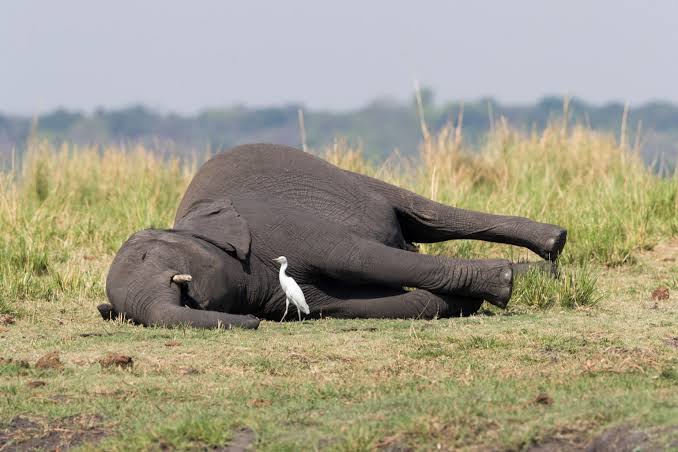
African elephants continue to shape savannas long after they die, with their carcasses altering soil chemistry, reducing plant and microbial diversity, and attracting grazing animals for years, a new study has found.
The research, published in the Proceedings of the National Academy of Sciences, examined 40 elephant carcass sites in South Africa’s Kruger National Park. Researchers found that decomposing elephant remains released large amounts of nutrients into the soil, creating long-lasting ecological changes that persisted years after the animals died.
On average, soil ammonium concentrations were 31 times higher at carcass sites than in surrounding areas, while nitrate levels were seven times higher and plant-available phosphorus was three times higher.
The paper’s findings challenge the assumption that an animal’s ecological influence ends when it dies. Instead, the researchers found that elephant carcasses create both hotspots of ecosystem activity and coldspots of biodiversity, where fewer plant and microbial species thrive.
“We know that these really charismatic megafauna have strong impacts on ecosystems while they’re alive, but until now we haven’t really understood how those impacts continue after they die,” said Courtney Reed, the study’s lead author and a former postdoctoral researcher at the University of California, Santa Barbara.
The team collected soil and plant samples from carcass sites ranging from eight days to 7.7 years after the elephants’ deaths. Samples taken close to the carcasses were compared with those collected 15 metres away to establish background conditions.
The researchers found that the effects extended underground and above ground, changing soil microbes, plant diversity and the feeding behaviour of herbivores.
At fresh carcass sites, ammonium concentrations reached nearly 3,000 times the levels recorded in surrounding soils. Rather than fertilising the ground and encouraging vegetation to grow, these extreme concentrations were associated with reduced plant diversity and biomass.
High ammonium concentrations were also associated with lower bacterial diversity. Both bacterial and fungal diversity declined at carcass sites, although fungal diversity recovered over time while bacterial diversity remained suppressed.
Despite the loss of microbial diversity, soil respiration—a measure of biological activity in the soil—increased at carcass sites. The effect lasted approximately one to two years before returning to levels recorded in surrounding soils.
Above ground, the nutrient-rich sites attracted herbivores, including impala and buffalo. These two animals, the most frequently recorded herbivores in the study, foraged at carcass sites at roughly three times the rate observed in surrounding areas.
The grasses growing at these sites contained about 1.5 times more nitrogen than those in surrounding areas, making them attractive to grazing animals. Researchers found that grazing intensity increased with carcass age, suggesting that herbivores continued visiting the sites years after the elephants died.
Increased grazing helped keep plant biomass low, while the animals’ dung and urine may have replenished soil nutrients, sustaining the cycle of nutrient enrichment and herbivore activity.
Plant diversity remained suppressed throughout the study period, while elevated nitrogen levels in grass showed little sign of declining even at the oldest sites.
The researchers said the findings highlight an overlooked ecological role of large animals: their remains redistribute nutrients and influence ecosystem processes long after death.
Kruger National Park, which has about 30,000 elephants, experiences roughly 600 elephant deaths annually, based on an estimated annual mortality rate of 2%. This suggests that thousands of carcass sites could be influencing the park’s ecology at any given time.
IMAGE CREDIT