What happens when a disease that has caused cancer for decades becomes less common? In Egypt, doctors have seen how bladder cancer patterns can change as the risks people face change. The experience offers a lesson for Africa, where cancer cases and deaths are rising.
Bladder cancer in Egypt was closely linked to schistosomiasis, also known as bilharzia for many decades. People can pick up the parasitic infection through contact with contaminated freshwater. Over time, it can damage the bladder and lead to cancer, as a study of Egyptian hospital and registry records explains.
Then in the 1990s, things changed. At Cairo’s Kasr Al Aini Hospital, researchers reviewed records of 1,932 bladder cancer patients treated between 2001 and 2010. The proportion of cases linked to schistosomiasis fell from 73% to 25%, while the share commonly associated with smoking rose from 20% to 66%. The study does not prove that controlling bilharzia caused the entire change, but it shows how cancer patterns can shift as exposures change.
Smoking is a major risk factor for bladder cancer. In a later study of 632 Egyptian bladder cancer patients, 67.9% were smokers. Tobacco also causes lung cancer. In a study of 123 lung cancer patients in Cairo, 93.5% had been exposed to tobacco smoke and almost half had worked around cement dust. Without a comparison group, the study cannot establish how much each exposure contributed. Still, reducing tobacco use and harmful workplace exposures could prevent some cancers.
The risks extend beyond smoking. The International Agency for Research on Cancer, the World Health Organization’s cancer research agency, classifies outdoor air pollution as a cause of lung cancer. Evidence has also linked it to bladder cancer, although its contribution in Egypt is not well quantified. The gap matters across Africa, where exposure to traffic fumes and industrial emissions is a growing concern.
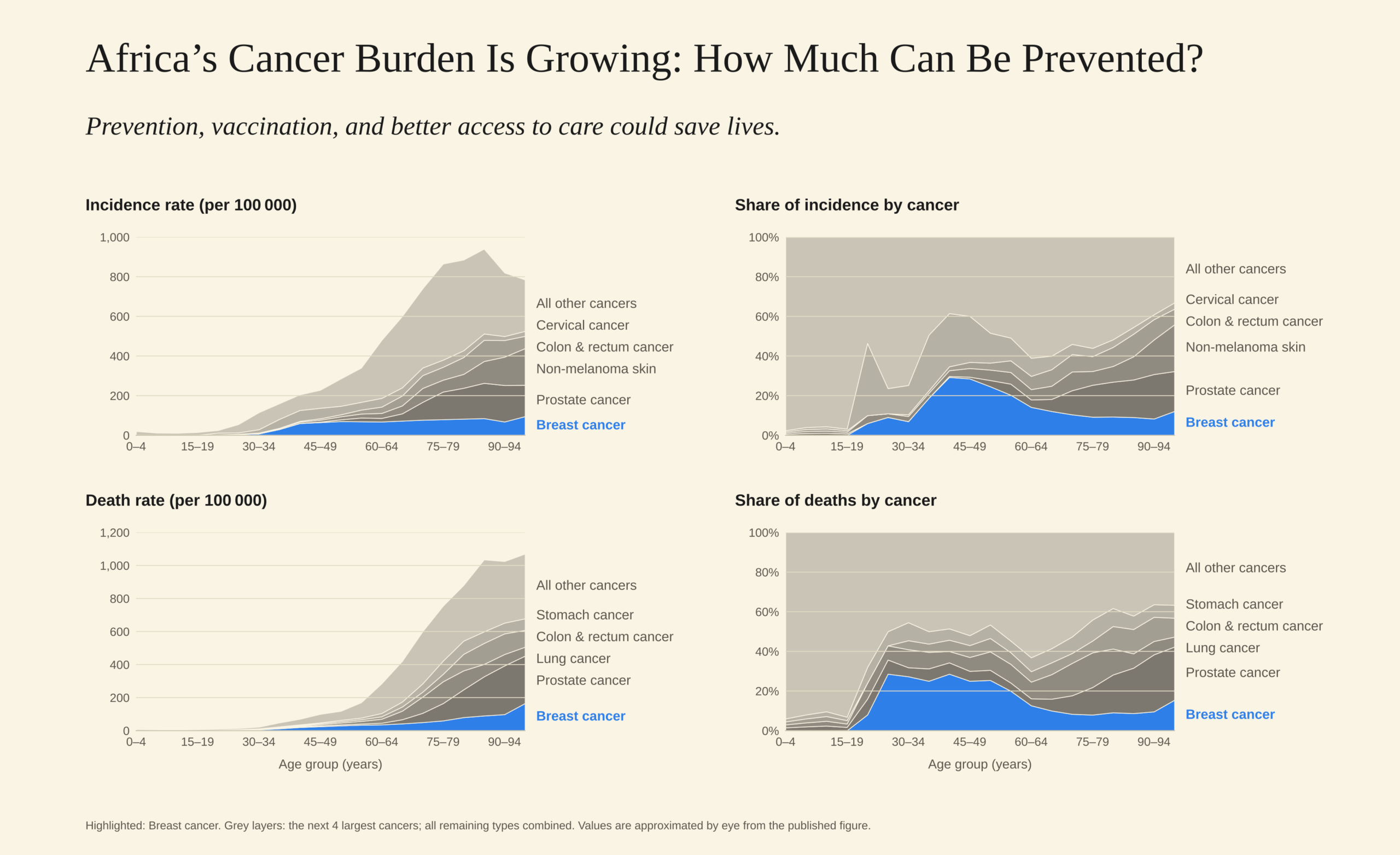
A study published in The Lancet Oncology examined cancer in all 54 African countries from 1990 to 2023, drawing on the Global Burden of Disease Study. Researchers estimated that Africa recorded 1.54 million new cancer cases and 923,000 deaths in 2023. Egypt alone accounted for about 121,000 new cases and 78,300 deaths.
Since 1990, cancer cases across Africa have risen by 229% and deaths by 185%. Population growth and ageing explain part of the increase. But after adjusting for population size and age, the cancer death rate was still 15.5% higher than in 1990, even as rates fell in wealthier regions. The authors describe cancer as “a growing contributor to the disease burden in Africa.”
The study estimated that about 306,000 African cancer deaths in 2023 were attributable to risk factors that could potentially be reduced. Tobacco was associated with around 72,000 deaths and air pollution with 18,400. The estimates may be incomplete because some cancer-causing infections common in Africa could not be included.
Breast and cervical cancer together account for 53.5% of new cancer cases among African women. Breast cancer was the continent’s leading cancer killer in 2023, with an estimated 129,000 deaths, followed by cervical cancer at 107,000. Cervical cancer can largely be prevented through HPV vaccination and screening, yet fewer than 35% of African countries have national HPV vaccination programmes.
Africa also bears a disproportionate share of childhood cancer deaths. The continent accounts for about 28% of the world’s childhood cancer cases but 38% of deaths. This suggests that children are more likely to die after diagnosis, potentially reflecting delayed diagnosis and limited access to treatment. Children account for 6.8% of cancer deaths in Africa, compared with 1% worldwide.
The key takeaway from this article is Egypt’s experience, which shows that addressing cancer risk can change disease patterns. Around Africa, tobacco control, cleaner air, vaccination, screening and earlier diagnosis could prevent illness and save lives. The challenge is to expand these tools while improving cancer records and access to care.