
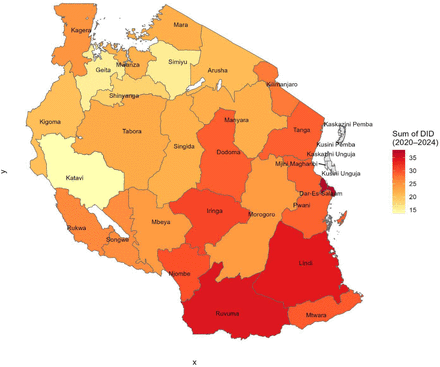
While research on antimicrobial resistance (AMR) in Tanzania has increased significantly over the past three decades, major gaps remain in understanding how drug resistance spreads across humans, animals, and the environment, according to a new study.
Published in The Lancet Regional Health – Africa, the study reviewed nearly 800 AMR-related studies conducted in Tanzania between 1972 and 2024.
The researchers found a sharp rise in scientific publications after 2004, reflecting growing national and global concern over infections that no longer respond to medicines such as antibiotics.
However, the research landscape remains heavily skewed toward human health.
“Nearly nine out of ten AMR studies in Tanzania focus only on human health, leaving animals and the environment dangerously understudied,” the study said.
According to the researchers, 88.5 percent of all studies focused exclusively on humans, while only 7 percent examined animals and just 1.6 percent investigated environmental sources such as water, soil, and waste.
Meanwhile, only a tiny fraction of studies examined all three sectors together using a “One Health” approach.
Experts warn that this imbalance creates critical blind spots because drug-resistant microbes can spread between people, livestock, and the environment.
The study also found that most AMR research in Tanzania focuses on antibiotic resistance in bacteria.
About two-thirds of all studies examined bacterial resistance, while resistance involving viruses, parasites, and fungi received far less attention.
Despite the growing volume of research, however, most studies have focused on measuring the scale of the problem rather than testing practical solutions.
“Most research tells us how big the resistance problem is, but far less research shows us how to solve it,” the study said.
The researchers noted that surveillance dominates the field, while critical areas such as infection prevention, antimicrobial stewardship, governance, and the economic impact of AMR remain underexplored.
Another major concern is funding. The study revealed that Tanzania relies overwhelmingly on foreign support to finance AMR research.
“More than 90 percent of AMR research funding comes from outside Tanzania, highlighting heavy dependence on foreign donors,” the study found.
The researchers say Tanzania must now shift from simply documenting drug resistance to investing in practical interventions, stronger domestic financing, and cross-sector collaboration to effectively combat the growing AMR threat.
Without that shift, they warn, efforts to contain antimicrobial resistance may struggle to keep pace with the rapidly evolving threat.
IMAGE CREDIT